Why Bitcoin Investment is Critical for Modern Entrepreneurs
Learning how to invest bitcoin has become essential for forward-thinking entrepreneurs. With more than 28 percent of Americans now using or investing in crypto, Bitcoin has moved from a fringe experiment to a legitimate asset class that demands attention.
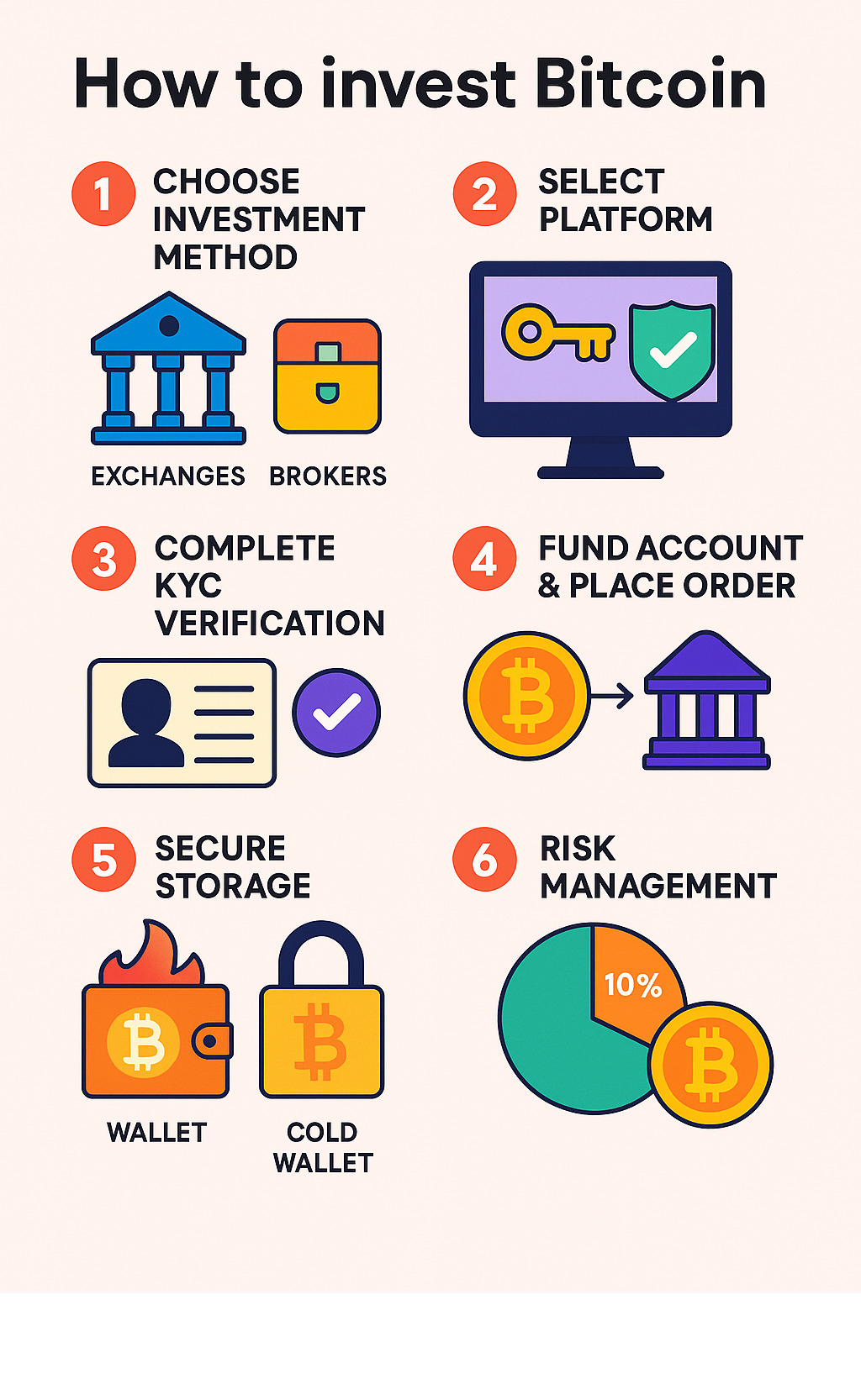
Quick Answer: How to Invest Bitcoin
- Choose your method: Crypto exchanges, traditional brokers, or Bitcoin ETFs
- Select a platform: Pick a reputable exchange like Coinbase or use your existing broker
- Complete verification: Provide ID, Social Security number, and link bank account
- Fund and buy: Transfer money and place your Bitcoin order (start with $10-100)
- Secure storage: Use a hardware wallet for large amounts, keep exchange wallet for small trades
- Manage risk: Never invest more than you can afford to lose (max 10% of portfolio)
Bitcoin hit new highs above $115,000 in early 2025, delivering a staggering 120.21% return over the past year. But here’s the reality check – it also dropped 6.76% in just one week, showing the extreme volatility that makes this both an opportunity and a risk.
As an entrepreneur, you already understand calculated risks. Bitcoin represents the ultimate asymmetric bet – limited downside (you can only lose what you invest) but potentially unlimited upside. The key is approaching it with the same discipline you bring to your business.
The crypto market operates 24/7, never sleeps, and doesn’t care about your business hours. This creates both opportunities and challenges that traditional investments don’t present. Understanding these dynamics is crucial before putting your hard-earned money at stake.
How to invest bitcoin word roundup:
Understanding the Basics: What is Bitcoin and Why Invest?
Before we dive into the “how-to” of how to invest bitcoin, let’s get a clear picture of what this digital phenomenon actually is. Why are so many people, especially forward-thinking entrepreneurs like us, considering it a serious investment?
At its simplest, Bitcoin is a form of digital money. It was introduced to the world in a 2008 whitepaper by a mysterious person or group known as Satoshi Nakamoto, officially launching in January 2009. Unlike the dollars or euros in our bank accounts, Bitcoin operates without a central bank or a single boss. Instead, it’s a decentralized currency, meaning transactions happen directly between people, peer-to-peer, without needing a traditional financial institution to act as a middleman.

The magic behind Bitcoin is a technology called blockchain. Think of it as a super-secure, public “digital ledger” that’s shared across thousands of computers worldwide. Every Bitcoin transaction gets added to this ledger in “blocks,” and once a block is recorded, it’s pretty much impossible to change. This creates a transparent, secure, and unchangeable history of every single transaction. If you’re curious to dig deeper, you can learn more about how crypto and blockchain technology works in detail.
What truly makes Bitcoin unique and has propelled its growth as a financial technology and digital asset? It comes down to a few key traits:
- Decentralization: As we mentioned, no single entity calls the shots. This means it’s less prone to government or central bank manipulation, offering a different kind of financial independence.
- Limited Supply: This is a big one! There will only ever be 21 million Bitcoins created. This scarcity is a fundamental part of its value, which is why it’s often called “digital gold.” Just like real gold, its limited nature makes it potentially valuable over time.
While there are countless cryptocurrencies out there, Bitcoin remains the undeniable leader. Alongside Ethereum, these two giants account for nearly two-thirds of the entire cryptocurrency market. This strong position suggests a level of established trust and liquidity that many newer digital assets simply don’t have. If you’re just dipping your toes into this world, our Crypto 101: A Beginner’s Guide to Understanding Cryptocurrency can give you a fantastic head start.
The Case for Bitcoin Investment
So, with a basic grasp of what Bitcoin is, why should we, as entrepreneurs, seriously consider adding it to our investment portfolio? Beyond the hype, there are compelling reasons that resonate with a business-minded approach to financial growth.
First, many view Bitcoin as a modern-day store of value, much like gold has been for centuries. Its limited supply means it’s naturally deflationary, making it a potential hedge against inflation for traditional currencies. This is why it appeals as a long-term holding.
Then there’s the concept of asymmetric risk. This is a favorite among entrepreneurs! With Bitcoin, your maximum downside is what you invest – you can only lose what you put in. However, the upside potential is theoretically unlimited. While past performance is never a guarantee, Bitcoin’s 1-year return was a staggering 120.21% as of early 2025. That kind of potential for high returns is rare in traditional markets, making it an attractive option for portfolio diversification.
Beyond just being an asset, Bitcoin represents groundbreaking technological innovation. Its underlying blockchain technology has the power to reshape many industries. It’s also evolving as a payment network, with innovations like the Lightning Network making transactions faster and cheaper. Finally, for those of us who value independence, Bitcoin offers a unique degree of financial sovereignty. It allows us to manage our own digital assets without relying on traditional banks, truly embodying the spirit of decentralization.
The Inherent Risks and Volatility
Now, let’s pump the brakes just a little and inject a healthy dose of reality. While the potential rewards are exciting, investing in Bitcoin is definitely not for the faint of heart. It’s crucial to understand the very real risks involved before you consider how to invest bitcoin.
The most talked-about risk is extreme volatility. Bitcoin’s price swings can be wilder than a rodeo clown, experiencing rapid price fluctuations. For example, while it boasted an incredible 120.21% return over one year, it also dropped by 6.76% in just one week around the same time. These dramatic shifts mean your investment value can change significantly in a very short period, often driven by market speculation rather than traditional financial metrics.
Another big factor is regulatory uncertainty. The rules for cryptocurrencies are still being written around the world. Different countries have different approaches, and sudden changes in regulations can have a big impact on Bitcoin’s price and how usable it is. It’s like trying to predict the weather years in advance – tough to do!
And here’s a crucial point: there’s a lack of traditional protections. Unlike money in a bank account or investments with a stockbroker, Bitcoin generally isn’t insured by government bodies like the FDIC (Federal Deposit Insurance Corporation) or SIPC (Securities Investor Protection Corporation). This means if an exchange gets hacked or goes bankrupt, your funds might not be protected.
Simply put, Bitcoin is a high-risk investment. Experts often caution that the broader crypto market is highly speculative. While Bitcoin is the market leader, we must be prepared for the possibility of losing what we invest. As entrepreneurs, we understand calculated risks, but this one requires extra caution. We recommend only investing what you can truly afford to lose without impacting your financial well-being. For more insights into common pitfalls, definitely check out The Biggest Crypto Mistakes Beginners Make and How to Avoid Them.
A Step-by-Step Guide on How to Invest Bitcoin
Alright, now that we’ve covered the “what” and the “why,” let’s get down to the “how.” Learning how to invest bitcoin doesn’t have to be complicated, but it requires a clear strategy, a dose of due diligence, and an understanding of our own risk tolerance and financial goals. Think of it like learning any new skill for your business – a few key steps, a bit of preparation, and you’re ready to go!

Step 1: Choose Your Investment Method
When it comes to putting your money into Bitcoin, you’ve got options! Each path has its own perks and quirks, especially when it comes to fees, ease of use, and how much direct control you have over your Bitcoin. Let’s break down the most common ways to get started. Understanding these differences will help you pick the method that best fits your comfort level and investment goals.
| Method | Fees (Typical Range) | Ease of Use (Beginner-Friendly) | Ownership (Direct vs. Indirect) | Security Considerations |
|---|---|---|---|---|
| Cryptocurrency Exchanges | 0.1% – 3.0% per trade | High | Direct | Varies; requires strong passwords, 2FA, and potentially self-custody. |
| Traditional Stockbrokers | Standard brokerage fees | Medium | Indirect (via ETFs/futures) | Brokerage-level security, but no direct Bitcoin ownership. |
| Bitcoin ETFs | Expense ratios (0.5% – 2.0%) | High | Indirect | Managed by fund; exposure to price without direct custody. |
| P2P (Peer-to-Peer) Apps | 0% – 1.0% (seller set) | Medium | Direct | Requires trust in counterparty; use escrow services. |
| Bitcoin ATMs | 5% – 15% (can be higher) | High | Direct | Convenient, but high fees and physical location required. |
As you can see, there’s no single “best” way. For most entrepreneurs just dipping their toes in, a cryptocurrency exchange is usually the most straightforward starting point. They offer a good balance of ease of use and direct ownership. However, if you prefer to invest through your existing financial relationships, a traditional stockbroker offering Bitcoin ETFs might be your jam.
Step 2: Select a Platform and Get Your Documents Ready
Once you’ve decided on your preferred method (likely a cryptocurrency exchange or a stockbroker for an ETF), it’s time to pick a specific platform. Think of this as choosing the right bank for your digital gold. Look for platforms with a strong reputation for security, good customer support, and reasonable fees. Popular choices for exchanges include Coinbase, Binance, Kraken, and Gemini, but always do your own research!
Before you can start buying, these platforms need to know who you are. This process is called KYC (Know Your Customer), and it’s a standard requirement to prevent fraud and comply with financial regulations. It might feel a bit like applying for a bank account, but it’s a crucial step for your security and the platform’s legitimacy.
To complete the KYC process, you’ll typically need a few things handy:
- A government-issued ID (like your driver’s license or passport)
- Your Social Security Number (for U.S. residents)
- A secure internet connection (avoid public Wi-Fi for financial transactions!)
- Your bank account or debit card details so you can fund your investment
Gathering these documents beforehand will make the sign-up process much smoother and faster.
Step 3: Fund Your Account and Place Your First Order
You’ve picked your method, chosen your platform, and verified your identity. Now for the exciting part – funding your account and making your first Bitcoin purchase!
Most platforms offer several ways to deposit money. The most common are:
- Bank transfer (ACH): This is usually the cheapest option, though it might take a few business days for funds to clear.
- Debit card: Often quicker, allowing instant purchases, but typically comes with higher fees.
Once your funds are in, you’re ready to place an order. You’ll usually have two main choices:
- Market order: This is the simplest. You tell the platform you want to buy Bitcoin, and it executes your order immediately at the current market price. It’s fast, but the price might fluctuate slightly between when you click “buy” and when the order fills.
- Limit order: This gives you more control. You set a specific price you’re willing to buy Bitcoin at. Your order will only execute if Bitcoin reaches that price or lower. This can be great for strategic buying, but your order might not fill if the price doesn’t hit your target.
For beginners, a market order is often the easiest way to start. Consider using a strategy called dollar-cost averaging (DCA). Instead of buying a large amount all at once, you invest a fixed amount regularly (e.g., $50 every week or month). This helps smooth out price volatility and can be a fantastic long-term strategy for building your Bitcoin holdings without trying to “time the market.”
Finally, remember to pay attention to fees! There are typically two types:
- Exchange fees: These are what the platform charges you for making a trade. They can be a percentage of your trade or a flat fee.
- Network transaction fees: These are paid to the Bitcoin network itself to process your transaction. These fees can vary wildly, from less than 50 cents to more than $100, depending on network congestion and the size of your transaction. While your exchange often handles these in the background, it’s good to be aware they exist. Always check your platform’s fee schedule before you buy.