Why Burnout Prevention for Entrepreneurs Is Critical to Your Success
Burnout prevention for entrepreneurs isn’t just about feeling better—it’s about survival. Here are the key strategies that work:
Quick Prevention Methods:
- Time blocking with 25-minute focus sessions and 5-minute breaks
- Delegate non-core tasks (admin, bookkeeping, customer service)
- Set boundaries with digital sunsets and weekend disconnection
- Exercise regularly to boost endorphins and reduce stress
- Use the 4 D’s: Do, Delay, Delete, or Delegate every task
Warning Signs to Watch:
- Chronic exhaustion that rest doesn’t fix
- Loss of motivation for work you once loved
- Physical symptoms (insomnia, headaches, high blood pressure)
- Snapping at team members or family
The numbers tell a sobering story. 42% of small business owners report experiencing burnout, with 53% saying it actively hurts their business success. Another study found that 48% of entrepreneurs burned out in just the past year alone.
Burnout isn’t just feeling tired after a long week. It’s a medical condition first identified by psychologist Herbert Freudenberger in the 1970s. The World Health Organization defines it as chronic workplace stress that leads to emotional, physical, and mental exhaustion.
For entrepreneurs, the stakes are higher. You’re not just risking your own health—you’re risking your business, your team’s livelihoods, and years of hard work. The good news? Burnout is predictable and preventable when you know what to look for.
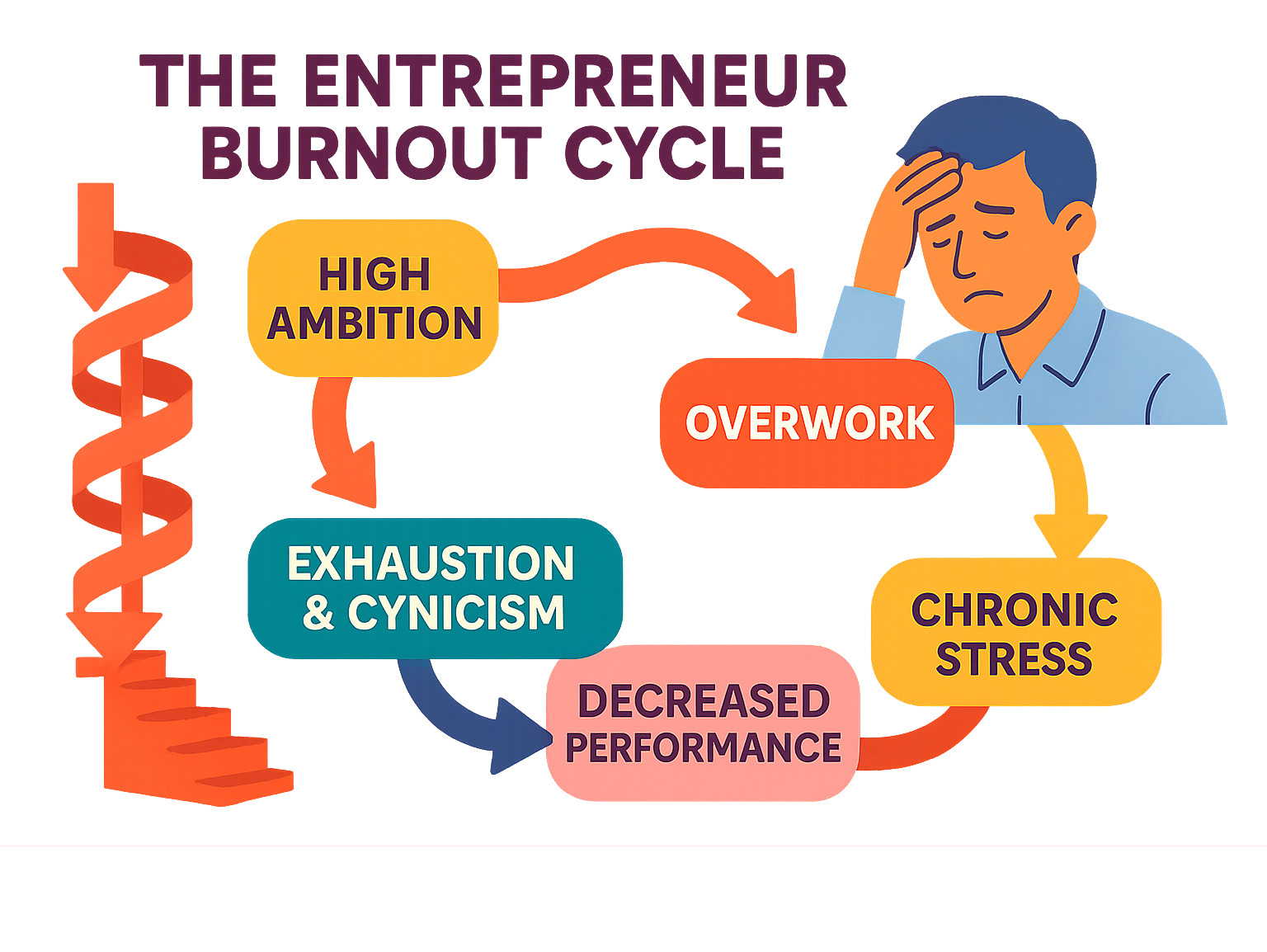
What Is Entrepreneurial Burnout & Why It Hits Hard
Picture this: you’re three years into building your dream company. You used to wake up excited about the day ahead, but now you drag yourself out of bed wondering if it’s all worth it. The passion that once fueled your late nights has turned into a heavy weight on your chest.
This is burnout prevention for entrepreneurs territory—and you’re not alone.
When psychologist Herbert Freudenberger first named “burnout” in the 1970s, he was watching healthcare workers hit their breaking point. But entrepreneurs face a perfect storm that makes us sitting ducks for this condition.
Christina Maslach identified three brutal components of burnout: emotional exhaustion, cynicism, and feeling like nothing you do matters anymore. For founders, these hit differently than they do for regular employees.
Unlike employees who can leave work at the office, your business follows you home, crawls into bed with you, and whispers in your ear during family dinners. You’re carrying your company’s future, your team’s paychecks, and probably your family’s financial security too.
The pandemic made everything worse. 42% of small business owners experienced burnout specifically from managing the chaos of the last few years.
Here’s what makes entrepreneurial burnout especially sneaky: startup culture celebrates the grind. We worship founders who pull all-nighters and sacrifice everything for their vision. But when that enjoyment slowly morphs into obligation, your passion becomes your prison.
Scientific research on burnout shows entrepreneurs are especially vulnerable because we lack the safety nets that traditional employees have. No HR department to turn to. No clear boundaries between work and personal time.
If you’re feeling the weight of crisis management, stress management during crisis can help you steer these challenging periods without burning out completely.
Stress vs. Burnout—Know the Difference
Stress is your body’s fire alarm. It goes off before that big investor pitch, but your brain still works. You can still problem-solve, still strategize, still push through. Most importantly, stress has an endpoint—once the presentation is over, you bounce back.
Burnout is when that fire alarm has been blaring for so long that you’ve stopped hearing it. Your body’s alarm system breaks down. You lose access to the motivation and creativity that once drove you.
| Stress | Burnout |
|---|---|
| Temporary and acute | Chronic and persistent |
| Maintains motivation | Loss of motivation and cynicism |
| Can access problem-solving | Impaired decision-making |
| Physical tension | Physical and emotional exhaustion |
| Recovers with rest | Requires systematic intervention |
| “Too much to do” | “What’s the point?” |
The scary part? Burnout doesn’t announce itself with a dramatic moment. It creeps in slowly, disguised as dedication and hard work. If a weekend off or a good night’s sleep doesn’t restore your energy and enthusiasm, you’re probably dealing with burnout, not just stress.
Spot the Red Flags Early
Think of burnout as a slow leak in your business engine. You don’t notice it at first, but one day you’re stranded wondering what went wrong. The secret to burnout prevention for entrepreneurs is becoming a detective of your own well-being.
Your body speaks first. Insomnia becomes your unwelcome companion, even when you’re bone-tired. You might find yourself getting sick more often, or dealing with headaches that seem to come from nowhere. High blood pressure and heart palpitations aren’t just stress—they’re your cardiovascular system waving a red flag.
Then your emotions start shifting. That excitement you once felt about Monday mornings? It’s replaced by a heavy feeling in your chest. You snap at your team over small issues, feel cynical about your industry, or find yourself emotionally numb during moments that should matter.
Finally, your behavior changes. You procrastinate on important decisions, rely more heavily on caffeine or alcohol to get through the day, and isolate yourself from support networks. Paradoxically, you work longer hours but accomplish less.
Here’s a simple test: the 2-month sustainability check. Look at your life over the past two months and ask yourself honestly: “If I repeat this exact pace and quality of life for the next year, how would I feel?” If the answer makes you cringe, you’re already in burnout territory.
More info about Entrepreneur Stress Management can help you develop better awareness of these patterns.
Tracking Tools & Check-Ins
Weekly resilience check-ins can be as simple as rating yourself on three questions: How energized do I feel about my work this week? What percentage of my time was spent on meaningful tasks versus busy work? How well did I maintain boundaries between work and personal life?
Your mentor or peer group can be your smoke detectors. Sometimes we’re too close to see our own changes. A good mentor notices when your communication style shifts from enthusiastic to just getting through conversations.
The goal isn’t to become obsessed with tracking every mood swing. It’s about developing the same awareness of your personal sustainability that you have for your business runway.
Proven Strategies for Burnout Prevention for Entrepreneurs
Here’s what successful entrepreneurs have learned about preventing burnout: it’s not about working less—it’s about working smarter. These strategies come from founders who’ve built thriving businesses while maintaining their health and sanity.
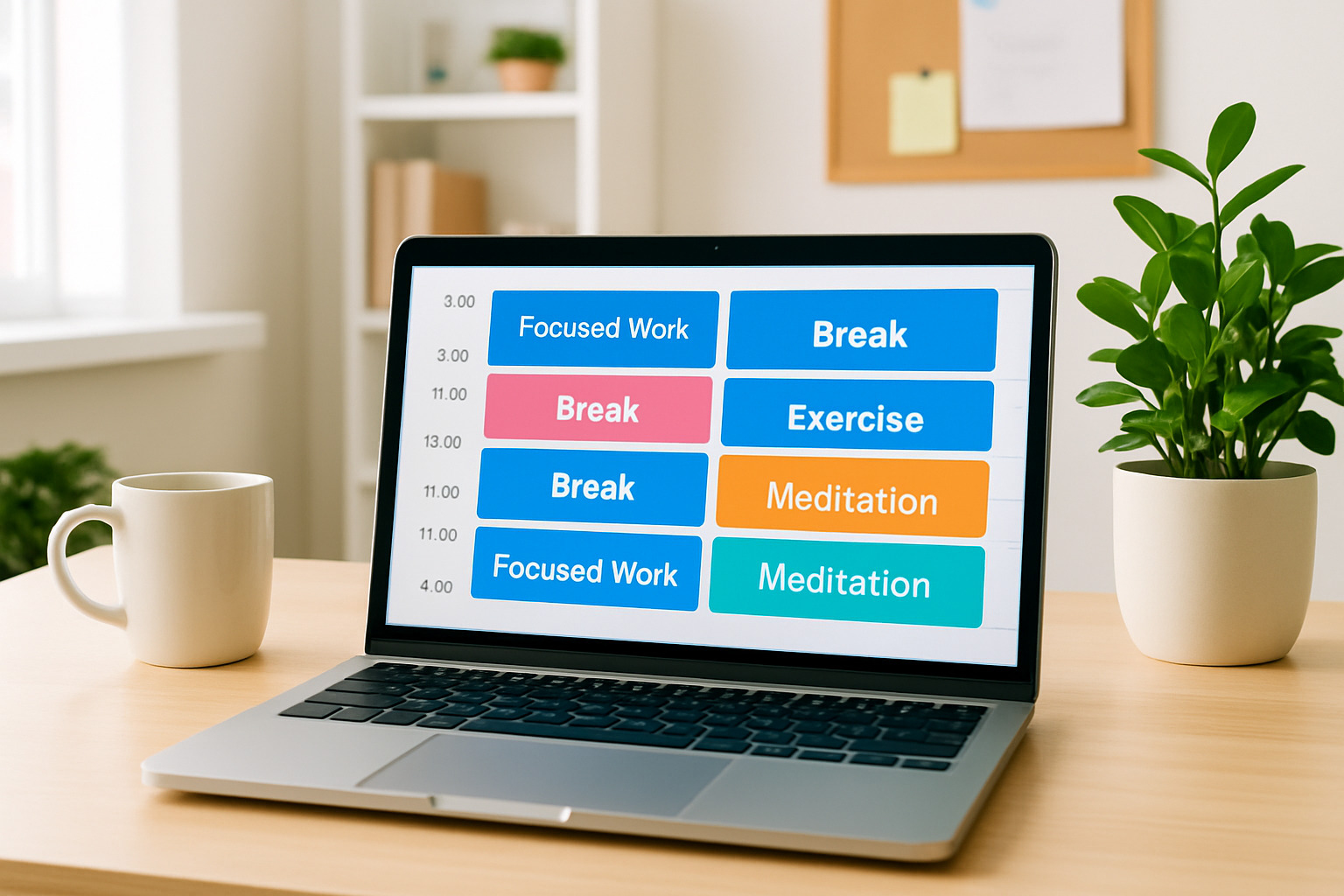
Time blocking transforms chaotic days into manageable chunks. The Pomodoro Technique—25 minutes of focused work followed by a 5-minute break—isn’t just about productivity. Those breaks reset your nervous system and prevent stress from building up.
The 4 D’s framework helps you handle every task: Do the high-impact tasks only you can handle. Delay important but non-urgent items. Delete low-value activities. Delegate everything someone else can do 80% as well as you.
Exercise acts like medicine for burnout prevention for entrepreneurs. It releases endorphins, improves sleep quality, and increases your resilience to stress. The key is consistency over intensity. A daily 20-minute walk beats sporadic intense workouts.
Sleep hygiene is non-negotiable. Poor sleep impairs your judgment, increases emotional reactivity, and reduces your ability to handle stress. Create consistent bedtime and wake times, avoid screens before bed, and never bring work materials into your sleeping space.
More info about Time Management Tips for Entrepreneurs offers additional strategies for structuring your day to prevent overwhelm.
Daily Self-Care Routines for Burnout Prevention for Entrepreneurs
Morning movement sets the tone for your entire day. Even ten minutes of stretching signals to your nervous system that you’re in control, not just reacting to whatever crisis awaits in your inbox.
Establish a digital sunset—a specific time when you close your laptop, silence work notifications, and transition to personal time. This boundary ritual is especially crucial for entrepreneurs who work from home.
End each day with gratitude and reflection. Write down three things you’re grateful for and one thing you accomplished. This simple practice helps maintain perspective during challenging periods.
More info about Journaling for Entrepreneurs can help you develop effective reflection practices.
Systems & Delegation for Burnout Prevention for Entrepreneurs
The most effective burnout prevention for entrepreneurs strategy is building systems that don’t require your constant involvement.
Hire true owners, not just employees. Find people who can own entire functions—a VP of Sales who builds the complete sales process, a COO who handles daily operations, a Marketing Director who develops strategy independently.
Outsource administrative tasks that drain your energy: bookkeeping, customer service, data entry, social media management, and website maintenance. Your time is worth hundreds of dollars per hour—stop doing $15/hour work.
Theme days reduce mental fatigue from constant context switching: Mondays for strategic planning, Tuesdays for sales calls, Wednesdays for team meetings, Thursdays for creative work, Fridays for administrative tasks.
More info about 7 Productivity Hacks Every Busy Entrepreneur Should Try provides additional systems for optimizing your workflow.
Time Management & Prioritization Hacks
The priority matrix helps you categorize every task. Urgent + Important tasks get done immediately. Important + Not Urgent items get scheduled. Urgent + Not Important tasks get delegated. Not Urgent + Not Important activities get deleted.
Tackle your hardest task first when your energy and decision-making capacity are at their peak. This prevents the afternoon slump that leads many entrepreneurs to work late trying to catch up.
Top 5 productivity apps: Todoist for task management, RescueTime for time tracking, Forest to stay focused, Calendly for automated scheduling, and Notion as an all-in-one workspace.
Setting Boundaries Between Work & Life
Digital detox strategies create space for your mind to rest. Turn off work notifications after a certain time. Use separate devices for work and personal use when possible. Create “phone-free” zones in your home.
Protect your weekends—or at least one full day per week where you don’t work. Your brain needs time to process information and generate new ideas. Many breakthrough insights happen during downtime.
Boundary rituals create clear transitions: change clothes when you finish work, take a short walk to “commute” home, close your laptop and put it away. These small actions help your mind shift gears.
Build your support network intentionally: other entrepreneurs who understand your challenges, mentors who provide perspective, friends and family who support your goals, and professional advisors when you need additional support.
Specialized Advice: Female & Neurodivergent Founders
Some entrepreneurs face extra layers of challenge that make burnout prevention for entrepreneurs even more critical.
The Double Bind Dilemma for Female Entrepreneurs
Female entrepreneurs steer the “double bind”—you need to be assertive enough to lead effectively, but not so assertive that you’re labeled as difficult. This constant balancing act creates enormous emotional labor that male founders don’t experience.
Add to this the caregiving load that still falls disproportionately on women’s shoulders. You might be running board meetings by day and managing school pickup and bedtime routines by night.
Strategic approaches include giving yourself permission to be “good enough” rather than perfect. Building a support network of other female entrepreneurs becomes crucial—they understand the unique challenges you face.
Neurodivergent Entrepreneurs and the ADHD Challenge
If you have ADHD, your creativity and ability to see connections are superpowers. But the constant task-switching and executive function challenges can fast-track you to burnout.
The Ice Cube approach can be a game-changer. Before tackling any task, ask yourself: “What is the actual ice cube here?” versus “What snow am I adding?” The ice cube is the core task. The snow is all the emotional baggage and overthinking you’re layering on top.
Strategic incompletion becomes your friend. Accept that not everything needs to be done to 100% completion. Many tasks deliver 90% of their value when completed to 80%.
Energy banking works particularly well for neurodivergent entrepreneurs. Categorize activities into energy deposits (tasks that energize you) and energy withdrawals (tasks that drain you). Make sure your deposits meet or exceed your withdrawals each day.
More info about How to Create a Balanced Lifestyle in a Busy World offers additional strategies for managing competing demands.
Recovery & Re-Ignition When You’re Already Burned Out
If you’re reading this thinking “Too late, I’m already burned out,” take a deep breath. Recovery is absolutely possible. Many successful entrepreneurs have walked this path and emerged stronger.
Acceptance is your starting point. Stop fighting the fact that you’re burned out. This isn’t a personal failure—it’s simply information about your current state.
Full disconnect comes next, and it’s non-negotiable. Unlike regular stress, burnout requires a complete break from work. We’re talking a minimum of 1-2 weeks where you don’t check emails, take “quick calls,” or peek at business metrics. Yes, this feels terrifying. Yes, your business will survive.
Professional support can accelerate your recovery. Consider working with a therapist, particularly one trained in Acceptance and Commitment Therapy (ACT). Scientific research on acceptance therapy shows it’s especially effective for entrepreneurs dealing with burnout.
Gradual re-engagement is crucial when you return. Don’t jump back into 60-hour weeks. Start with the most meaningful, high-impact activities that originally excited you about your business.
Reconnecting with your ‘why’ often becomes the bridge back to passion. Spend time journaling about why you started your business, what impact you want to make, and what success really means to you.
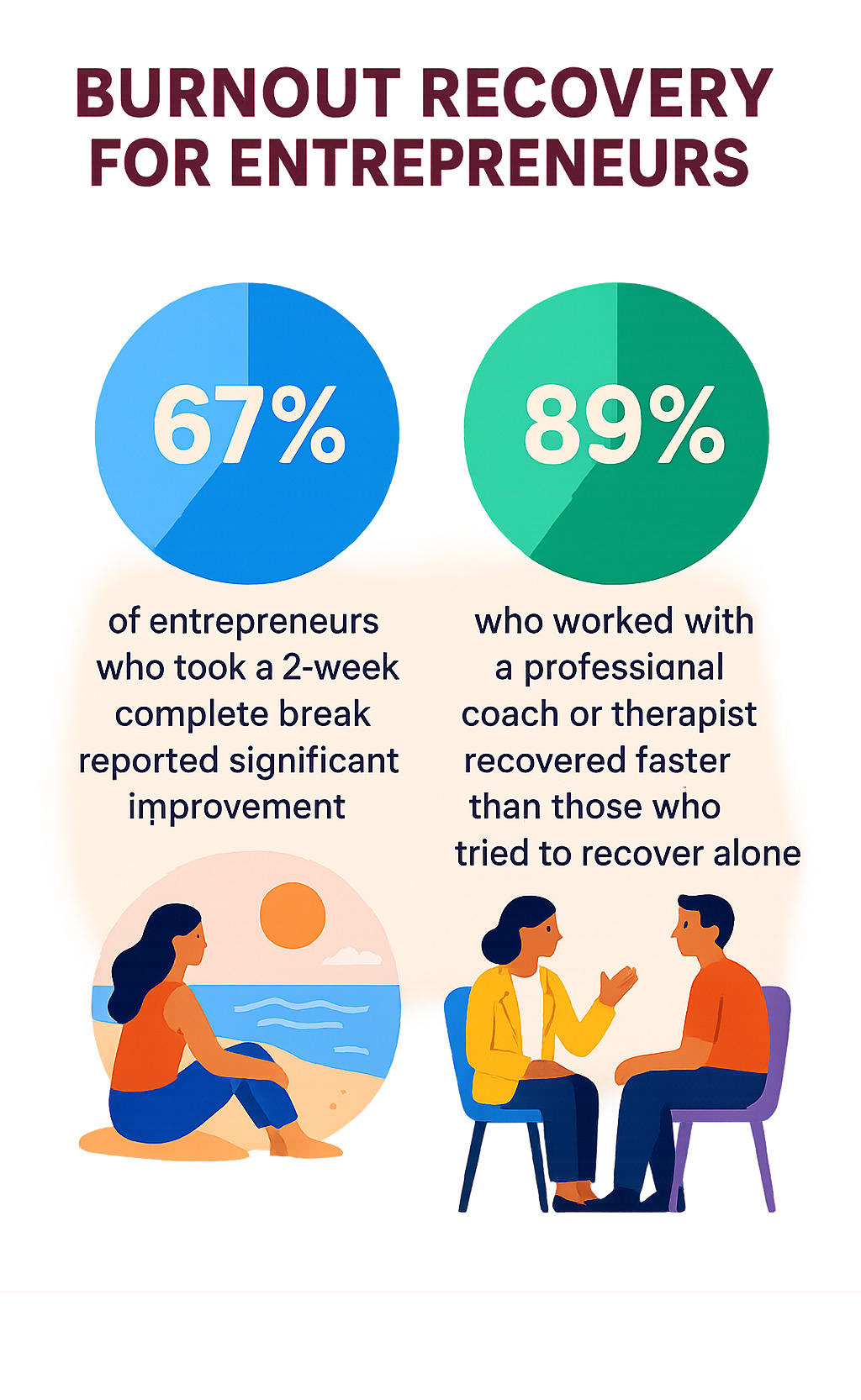
Three-R Framework to Bounce Back
Respite is about giving your nervous system time to reset. Spend time in nature, practice mindfulness, and engage in activities that bring you genuine joy, not just distraction.
Reappraisal involves changing how you think about stress and challenges. Working with a therapist or coach becomes invaluable here. They can help you identify and challenge thought patterns that contributed to your burnout.
Regimen is about building new, sustainable structures. Establish regular sleep and wake times, plan your days in advance to reduce decision fatigue, and create morning and evening routines that bookend your workday.
Recovery isn’t linear. You’ll have good days and setbacks. The key is treating yourself with compassion—you’re building the foundation for a more sustainable entrepreneurial journey.
Frequently Asked Questions about Entrepreneur Burnout
How can I tell if I’m approaching burnout or just stressed?
The key difference isn’t how tired you feel—it’s about duration and recovery. Stress is like a sprint with an endpoint. Burnout is like running a marathon at sprint pace—you’re chronically depleted, and no amount of rest seems to help.
Here’s the test: the 2-month sustainability check. Ask yourself: “If I had to maintain exactly this pace for the next two months, could I do it?” If your immediate reaction is “No way,” you’re already in burnout territory.
Other telltale signs include losing motivation for work you once loved, feeling cynical about your industry, having physical symptoms that don’t improve with rest, and struggling to make simple decisions.
What’s the quickest way to lower my burnout risk this week?
Start with a calendar audit. Cancel or delegate at least 20% of your scheduled commitments. Most entrepreneurs are shocked by how little actually falls apart when they do this.
Implement the 4 D’s framework for every task: Do (high-impact, only you can handle), Delay (important but not urgent), Delete (low-value busy work), or Delegate (someone else can do it 80% as well).
Take real breaks during your day—step away from work for at least 30 minutes. Set a digital sunset where you stop checking work emails. Ask for help with one specific task this week.
When should I seek professional help instead of DIY fixes?
Consider professional help if you’re experiencing persistent physical symptoms like chronic insomnia, frequent headaches, or digestive issues that don’t improve with self-care.
Mental health warning signs include thoughts of self-harm, increasing reliance on substances to cope, inability to concentrate, or persistent hopelessness about your business.
If your relationships are suffering or you’ve lost interest in activities you once enjoyed, a professional can provide valuable support. Many successful entrepreneurs credit working with a therapist with saving both their health and their businesses.
Conclusion
Think of burnout prevention for entrepreneurs as the ultimate business strategy—one that protects your most valuable asset: you. The difference between entrepreneurs who build lasting companies and those who flame out isn’t just talent or luck. It’s learning to sustain yourself for the long haul.
Entrepreneurship isn’t a sprint where the fastest person wins. It’s more like an ultra-marathon where staying power matters more than speed. As one battle-tested founder told me: “All the magic happens if you can just stay in the game long enough.”
The strategies we’ve explored—time blocking, delegation, boundary setting, and daily self-care routines—aren’t just feel-good advice. They’re the infrastructure that keeps high-performing entrepreneurs running strong year after year.
Start small, but start today. Maybe it’s finally hiring that virtual assistant. Or setting a digital sunset at 8 PM and sticking to it. Perhaps it’s taking that first real lunch break you’ve had in months.
These seemingly small changes create ripple effects. Better boundaries lead to better sleep. Better sleep improves decision-making. Better decisions reduce stress. Less stress means more creativity and energy for the work that truly matters.
Your business deserves the best version of you—not the exhausted, decision-fatigued version that burnout creates. When you prioritize burnout prevention for entrepreneurs, you’re making a strategic investment in your company’s future.
The entrepreneurs who’ve built the most successful, sustainable businesses all share one trait: they learned to take care of themselves with the same intentionality they bring to their business strategy. They understand that burning out doesn’t make you a hero—it makes you unavailable for the people and mission that matter most.
More info about lifestyles and additional resources can help you create the kind of entrepreneurial life you actually want to live.
Remember: taking care of yourself isn’t selfish—it’s the most generous thing you can do for everyone who depends on you. Choose sustainability. Choose longevity. Choose to stay in the game.