

Why Automation Tools for Business Are No Longer Optional
Automation tools for business have become the difference between startups that scale and those that burn out. If you’re still doing everything manually, you’re not just working harder – you’re falling behind competitors who’ve figured out how to work smarter.
Top Business Automation Tools by Category:
- Workflow Automation: Zapier, Microsoft Power Automate, Make
- Marketing Automation: HubSpot, Mailchimp, ActiveCampaign
- Robotic Process Automation: UiPath, Automation Anywhere, Blue Prism
- Finance Automation: QuickBooks, Xero with automated workflows
- Customer Support: Intercom, Zendesk with AI chatbots
- All-in-One Platforms: Pipefy, Bizagi, Appian
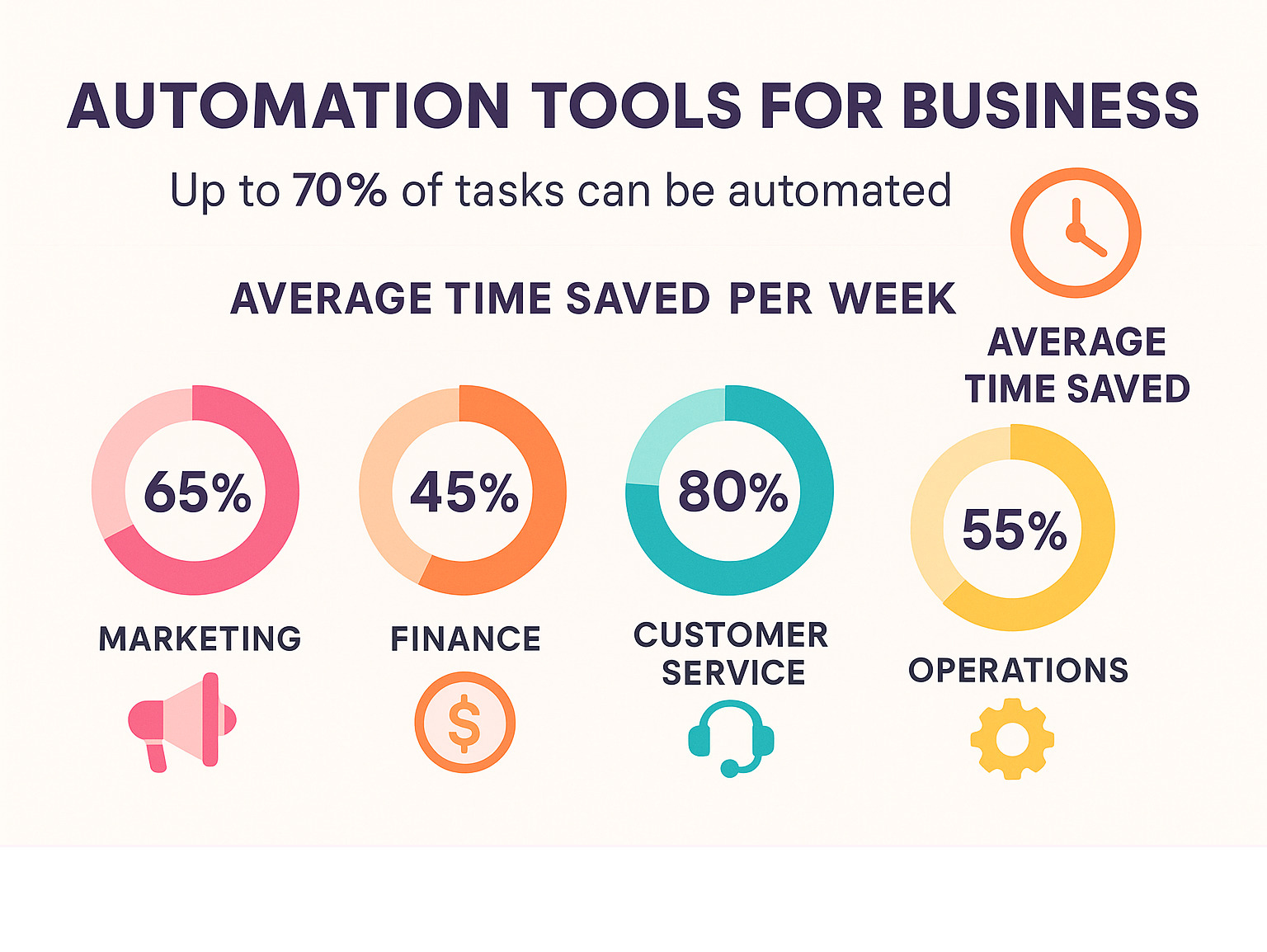
The numbers tell the story. Up to 70% of all employee tasks could soon be automated, according to McKinsey’s research. That’s not just busy work – that’s real time you could spend on strategy, growth, and the things only humans can do well.
Here’s what’s happening: while you’re manually updating spreadsheets and sending follow-up emails, your competitors are using tools that do this work automatically. They’re closing deals faster, serving customers better, and scaling without hiring armies of people.
The good news? Most of today’s automation tools are built for non-technical founders. You don’t need a computer science degree to set up workflows that save hours every week.
Why Startups Can’t Ignore Automation
Startups that accept automation early gain three critical advantages:
Time Savings That Compound
When you automate your first workflow, you might save 2-3 hours per week. But you use those saved hours to automate another process, then another. One startup automated their lead qualification process and freed up 60 hours per week that they redirected into actual sales conversations.
Cost Reduction Without Layoffs
Automation doesn’t replace people – it amplifies them. Instead of hiring three customer service reps, you might hire one and let automation handle routine inquiries. Automation can yield workforce capacity equivalent to adding 2.4 million full-time employees across the economy.
Competitive Edge Through Speed
When your competitors take days to follow up with leads, you respond in minutes. Speed becomes your superpower, and customers notice.
Business Process Automation 101 – The Engine Behind Modern Growth
Think of Business Process Automation (BPA) as hiring the world’s most reliable assistant – one who never calls in sick, never makes the same mistake twice, and works 24/7 without complaining about overtime.
Automation tools for business are simply software that handles the predictable, repetitive parts of running a company. We’re not talking about replacing human creativity – we’re talking about freeing you from mind-numbing tasks that eat up your day.
Modern BPA works through process mapping to visualize workflows, rule-based workflows for “if this, then that” logic, and AI assistance for tasks needing intelligence. Meanwhile, compliance logs get generated automatically.
McKinsey found that 70% of business activities could benefit from automation. That’s real time you could spend growing your business instead of drowning in it.
What Is BPA and How Does It Help?
Business Process Automation transforms manual tasks into smooth, repeatable processes.
Error Reduction Protects Your Reputation
Automated processes follow the exact same steps every time. No coffee-deprived mistakes at 6 AM, no rushing through tasks on Friday afternoon. One business owner cut their billing errors by 95% after automating their invoice process.
Scalability Without Chaos
Manual processes break when you need them most. You land three new big clients, and suddenly your systems fall apart. Automation scales seamlessly – whether you’re handling 50 orders or 5,000.
Auditability Gives Peace of Mind
Every automated workflow creates a detailed trail of what happened and when. This visibility helps with investors, compliance auditors, and your own team tracking.
Key Features Every Tool Must Offer
Low-Code Builder That Makes Sense
You shouldn’t need a computer science degree to automate your business. The best platforms let you build workflows by dragging and dropping visual elements.
Integrations That Work Reliably
An automation tool is only useful if it connects your existing apps. Focus on whether the specific connections you need work well, not just whether they exist.
Analytics That Show Real Impact
You need proof that automation is helping. The best platforms provide clear dashboards showing workflow performance and ROI.
Security and Governance You Can Trust
Look for platforms with proper certifications, encryption, and granular permission controls.
Mobile Access for Real Flexibility
Your business doesn’t stop when you leave the office. The best platforms offer mobile apps for managing workflows anywhere.
The Ultimate Guide to Automation Tools for Business
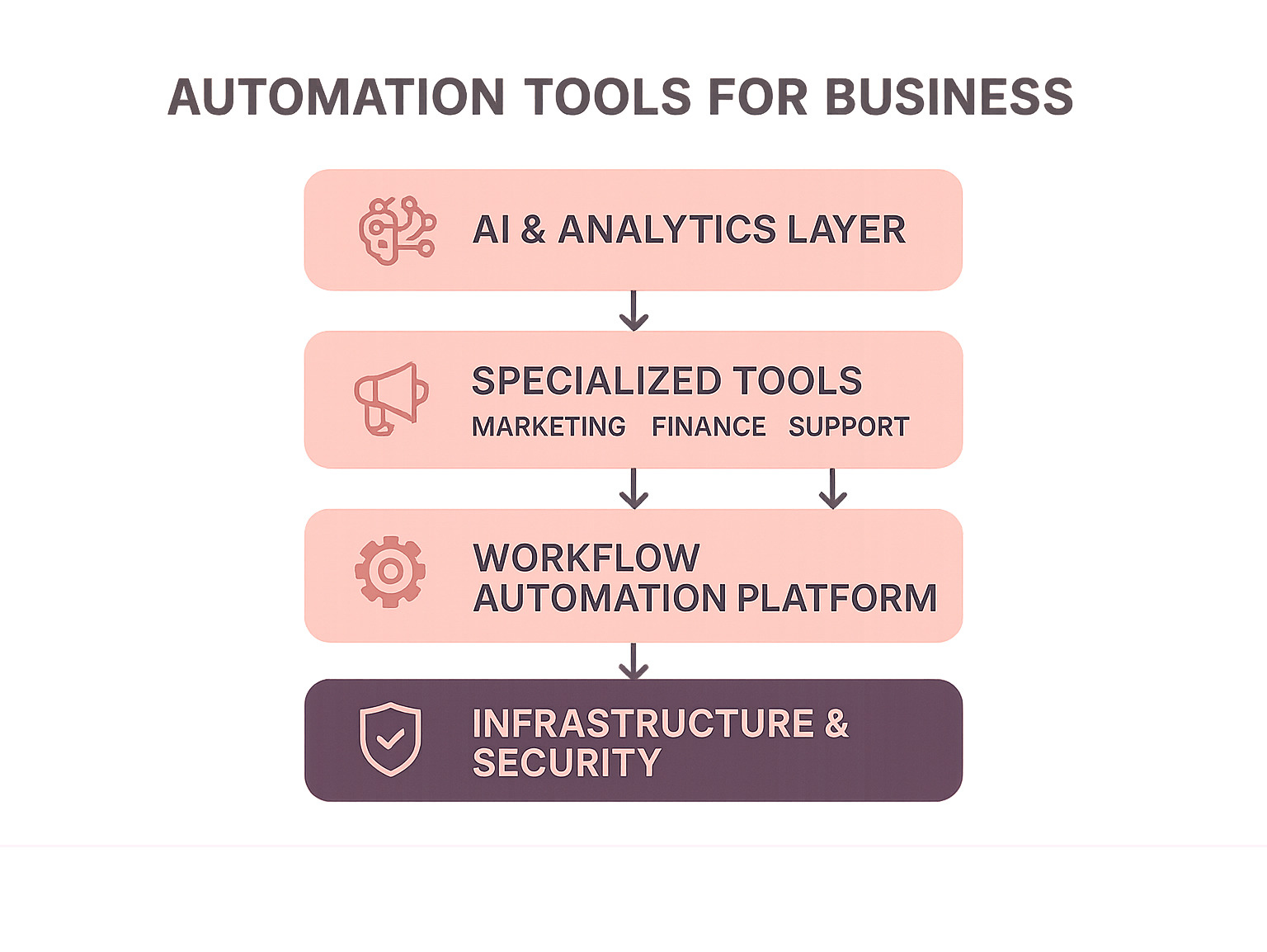
The automation tools for business landscape has five main categories. Most successful startups build an “automation stack” – a carefully chosen collection of tools that handle different business parts and work together seamlessly.
Workflow Automation Platforms – “Glue” of Your Tech Stack
Workflow automation platforms are like conductors ensuring all your tools work in harmony.
Drag-and-drop flows match how your brain works. Instead of writing code, you draw your process on screen. Make’s visual platform excels at intuitive design, while Zapier keeps things simple with step-by-step approaches.
Cross-app triggers create the real magic. A new customer signup instantly creates their account, sends login details, adds them to billing, starts welcome emails, creates success team tasks, and logs everything in analytics.
Real-time alerts keep you informed without overwhelming you. Set notifications for high-value leads or critical workflow failures.
Robotic Process Automation Suites – Digital Hands for Repetitive Tasks
RPA bots interact with software like humans do – clicking buttons, filling forms, and copying data.
Screen scraping extracts information from systems that don’t integrate well. Attended automation works alongside you, while unattended automation runs independently.
Exception handling separates professional RPA from amateur attempts. Great platforms anticipate problems and have backup plans.
Marketing & Sales Automation Hubs – Growth on Autopilot
Modern marketing automation orchestrates complex customer journeys that adapt in real-time.
Multichannel campaigns follow customers across Facebook, email, SMS, and retargeted ads. Omnisend offers impressive capabilities even on free plans.
Lead nurturing gradually moves prospects from curious visitors to enthusiastic customers. HubSpot excels at long-term relationship building.
A/B testing becomes effortless with platforms like ActiveCampaign, which offers multilingual workflows in five languages.
For deeper insights on sales integration, check our guide on CRM software for small businesses.
Finance & Ops Automators – From Quote-to-Cash to Inventory
Invoice generation eliminates cash flow delays by generating invoices when work completes. QuickBooks Advanced offers robust features starting at $25/month.
Cash-flow forecasting analyzes historical data and outstanding invoices to predict your financial position weeks ahead.
Inventory sync keeps stock levels synchronized across all sales channels in real-time.
Customer Support & Success Bots – 24/7 Service Without Burnout
Ticket routing ensures the right person sees problems at the right time based on urgency, topic, and customer tier.
Knowledge-base responses provide instant solutions through AI-powered chatbots that seamlessly transfer complex issues to human agents.
Sentiment analysis monitors communications for frustration signs and automatically escalates relationship risks.
The broader automation impact continues evolving, as explored in this research on consumer expectations.
How to Pick the Perfect Stack for Your Startup
There’s no “perfect” tool, but there is a perfect approach to finding the right combination that solves your problems instead of creating new ones.
Start with what’s actually broken. Document where your team wastes time weekly. Which tasks make people groan? What processes keep you up at night?
Your existing software should drive choices. List every tool your team uses daily, then evaluate how well automation platforms integrate with these systems.
Calculate the real cost. Factor in setup time, training hours, and troubleshooting. Most tools pay for themselves within months when you account for full implementation.
Use free trials extensively. Build actual workflows with real business data. Brevo offers 300 daily emails free, while Mailchimp serves 500 contacts free.
For more team process strategies, check our guide on small business productivity tools.
Evaluation Checklist
Does it solve your biggest pain points first? The tool should tackle high-volume processes and eliminate error-prone manual tasks.
What’s the real budget impact? Look beyond monthly costs to include implementation, training, and feature charges.
Can it grow with you? The platform should handle ten times your current volume and offer enterprise features without forcing you to restart.
How good is support when things break? Evaluate response times and implementation help availability.
Comparing Low-Code vs. Pro-Code Approaches
Low-code platforms get you started immediately with visual builders requiring zero programming. You can create workflows in days, with platforms handling maintenance and updates. Most cost $20-200 monthly.
Trade-off: You’re limited to platform capabilities.
Pro-code solutions offer unlimited flexibility since you build exactly what you need. Once built, ongoing costs are typically lower.
But custom development takes months, requires significant upfront investment, and demands ongoing technical resources.
For most startups, low-code platforms are the smart starting point for automating 80% of needs quickly and affordably.
Real-World Use Cases & Success Roadmap
The best way to understand automation’s impact is through concrete examples from startups across different industries.
Small Business Wins
Email Drip + CRM Sync Success
A B2B software startup automated their lead nurturing process. When someone downloads content, the system adds them to CRM, applies tags, and starts personalized email sequences. Result: 40% higher lead-to-customer conversion while reducing manual work by 15 hours weekly.
Social Post Scheduling Revolution
A marketing agency used Buffer’s automation to schedule posts across multiple client accounts. Instead of manual posting throughout the day, they batch work and let automation handle distribution. This freed 20 hours weekly for strategy and client relationships. Buffer’s Essentials plan at $5/month per account made this cost-effective.
Cash-Flow Alerts That Prevent Crisis
A retail startup set up automated cash flow monitoring with alerts for low balances and overdue invoices. These early warnings prevented two potential cash crunches and helped negotiate better supplier payment terms.
For more automation ideas, check our guide to AI tools for startups.
Enterprise-Level Playbooks
End-to-End Procure-to-Pay Automation
A manufacturing company automated procurement from requisition to payment. The system routes approvals, generates purchase orders, matches invoices, and processes payments. They reduced processing time from weeks to days and eliminated 95% of manual errors.
Hybrid RPA + AI Document Processing
A financial services firm combined RPA with AI for loan applications. RPA extracts data while AI validates information and makes preliminary decisions. Only edge cases need human review, processing 80% of applications automatically.
Frequently Asked Questions about Automation Tools for Business
How much can startups really automate without developers?
You can automate surprisingly sophisticated processes without writing code. Automation tools for business now put enterprise-level capabilities into non-technical founders’ hands.
Modern no-code platforms handle complex workflows that used to require custom development. You can build intricate email campaigns, lead qualification systems, and customer onboarding sequences. Tools like Zapier and Make have visual builders for workflows as complex as your business logic demands.
The scope keeps expanding. You can automate invoice generation, inventory management across sales channels, basic customer support with chatbots, and social media campaigns responding to engagement patterns.
But boundaries exist. You’ll need technical help for complex data changes, custom integrations with proprietary systems, advanced AI implementations, and high-volume real-time processing.
Start with no-code solutions and add technical complexity only when hitting specific walls that can’t be solved otherwise.
What security or compliance pitfalls should I watch for?
Data access becomes complex when connecting multiple systems. Use the principle of least privilege – give each process only minimum required access. Regular permission audits become essential.
API key management trips up many startups. Store keys securely, rotate regularly, and never share in documentation. Consider dedicated service accounts with limited permissions for automation.
Compliance logging takes new importance when processes run automatically. Look for SOC 2 Type II certification, GDPR compliance, and industry-specific certifications.
How long until we see ROI from automation investments?
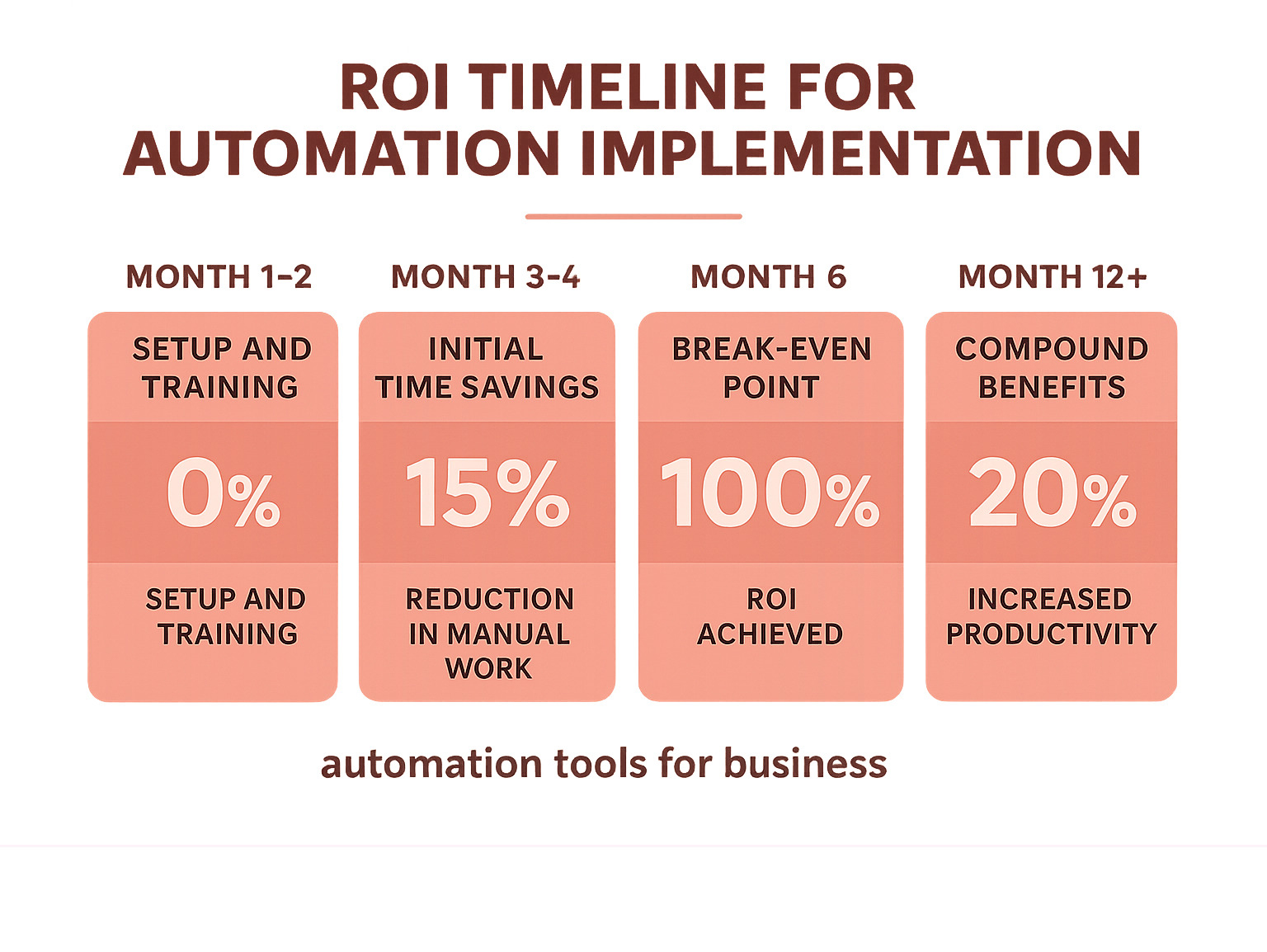
Most startups see positive returns within three to six months.
Quick wins appear within the first month. Email automation and social media scheduling often pay for themselves immediately, saving hours weekly from day one.
Medium-term returns develop over three to six months with complex workflows like customer onboarding and financial processes.
Real magic happens after six months when compound benefits kick in – process optimization, easier scaling, lower error rates, and improved customer satisfaction.
Start with high-impact, low-complexity automations for immediate relief, then build momentum for more sophisticated automation.
Conclusion
Here’s the truth: automation tools for business aren’t just nice-to-have anymore – they’re essential for survival. While some entrepreneurs are still wondering if they should automate, the winners are already building it into their business DNA.
Building a Future-Proof Strategy
The smartest startups don’t just buy automation tools and call it done. They create a continuous improvement culture where everyone looks for ways to work smarter, not harder. They regularly ask themselves: “What are we still doing manually that could be automated?” This mindset becomes a competitive advantage that grows stronger over time.
Think of automation as compound interest for your productivity. The time you save this month gets reinvested into automating something else next month. Before you know it, you’ve transformed how your entire business operates.
Starting Your Automation Journey
Don’t let the endless options paralyze you. Pick one painful process that eats up your time every week and automate that first. Maybe it’s following up with leads, sending invoices, or answering the same customer questions over and over.
The magic happens when you realize automation isn’t about replacing human creativity – it’s about freeing up your brain for the work that actually moves your business forward. When you’re not drowning in routine tasks, you can focus on strategy, innovation, and building the relationships that create real growth.
Your Next Steps
At TheEntrepreneurs.net, we believe every entrepreneur deserves access to the tools and knowledge that level the playing field. Our resource hub keeps growing with practical guides, honest tool comparisons, and strategies that work in the real world – not just in theory.
Ready to make every hour count? Check out our time management tips for entrepreneurs to squeeze even more value from your newly automated workflows.
The future belongs to businesses that can scale intelligently. With the right automation tools working behind the scenes, you’re not just keeping up – you’re positioning yourself to win whatever challenges come next.
Start small, think big, and remember: every minute you save through automation is a minute you can invest in building something amazing.












[…] automation tools for business […]